

Starting a building project is an exciting step, whether you’re extending your home, renovating a commercial property, or carrying out major structural work. However, construction work can sometimes lead to concerns about damage to neighbouring properties or disagreements over whether an issue existed before the work began. This is where a Schedule of Condition Burnley becomes one of the most valuable documents in the entire project.
By recording the condition of a property before work begins, a professionally prepared Schedule of Condition creates a trusted point of reference. This can significantly reduce the risk of disagreements, insurance issues and expensive legal disputes later in the project.
At Jason Edworthy Burnley, our professionally prepared Schedule of Condition reports provide homeowners, developers, contractors, and adjoining owners with clear, accurate documentation before any construction work begins, helping to reduce risk and provide confidence throughout the project.
What Is a Schedule of Condition and Why Does Every Building Project Need One?
A Schedule of Condition is a comprehensive report that records the current condition of a building or structure before nearby construction work takes place. It documents visible defects, structural features and the general condition of the property using written observations and high-quality photographs.
The purpose is simple: create an impartial record that everyone can rely upon if concerns about damage arise later.
Although Schedule of Condition reports are commonly prepared for Party Wall matters, their benefits extend far beyond these projects. They are widely used before a variety of construction works, including:
- Extending your home
- Converting an unused loft into living space
- Building or excavating a basement
- Refurbishing commercial premises
- Constructing new residential or commercial buildings
- Carrying out demolition work
- Making structural changes to an existing property
- Large-scale infrastructure and engineering works
Before construction begins, a professionally prepared Schedule of Condition creates a detailed record of the property’s existing condition. Instead of relying on memory or differing opinions later, it provides clear, independent evidence that can be used if questions about damage or changes arise during or after the project. See here: Party Wall Surveyor Fees Explained: Who Pays, How Much, and Why
This protects everyone involved—not only neighbours but also property owners, builders, developers and insurers.
Having this documentation often prevents disagreements from escalating because there is a clear benchmark showing exactly what was present before construction started.
How a Schedule of Condition Protects Property Owners, Contractors and Neighbours from Costly Disputes
Construction projects naturally involve vibration, excavation, heavy machinery and structural alterations. Even when work is carried out carefully, neighbours may notice cracks, movement or cosmetic defects and believe the project caused them.
Without evidence, determining the true cause can become difficult. A professional Schedule of Condition helps by providing an independent snapshot of the property’s condition before work commenced.
This protects property owners because they can demonstrate whether damage existed beforehand. It also protects contractors by preventing them from being unfairly blamed for pre-existing defects. Check out What Happens If You Ignore the Party Wall Act? Real Consequences for UK Homeowners
Neighbouring property owners benefit too, as genuine new damage can be identified more easily when compared with the original report.
The report can also support:
- Insurance claims
- Party Wall matters
- Property surveys
- Expert investigations
- Dispute resolution
- Legal proceedings if required
Perhaps most importantly, having an independent record often discourages unnecessary disputes altogether. When everyone knows detailed photographic and written evidence is available, disagreements are usually resolved much more quickly.
At Jason Edworthy Burnley, every Schedule of Condition report is prepared with accuracy, impartiality and attention to detail, giving all parties confidence that the documentation can be relied upon if questions arise during or after construction.
What Happens If You Start Building Work Without a Schedule of Condition?
Many property owners don’t appreciate the value of a Schedule of Condition until a dispute has already arisen.
Without one, it becomes much harder to establish whether damage is genuinely new or was already present before work began.
This can create several problems.
Existing defects become difficult to prove
Older properties commonly have small cracks, uneven floors or cosmetic wear that have developed over many years.
If these are not recorded before work starts, someone may later assume they resulted from the construction project.
Disputes can become expensive.
Resolving disagreements without clear evidence often requires additional surveys, expert reports and legal advice, all of which increase costs and delay projects.
Insurance claims may become more complicated.
Insurers frequently require evidence when assessing claims relating to alleged building damage.
A detailed Schedule of Condition provides valuable supporting documentation.
Relationships with neighbours may suffer.
Building work already disrupts noise, deliveries and temporary inconvenience.
If damage is suspected but cannot be verified, tensions can quickly escalate and affect relationships long after the project has finished.
Project delays may occur.
Investigating claims during construction can delay work while surveyors inspect the property and determine the likely cause of any damage.
Preparing a Schedule of Condition before work begins is far more efficient than trying to reconstruct events months later.

What Should a Professional Schedule of Condition Include?
Not all Schedule of Condition Burnley reports offer the same level of detail. A thorough report should provide enough information for meaningful comparisons if future inspections become necessary.
A professionally prepared report typically includes:
1. High-quality photographs
Clear photographs help create an accurate record of the property by showing both wider views of the building and close-up images of specific features or existing issues. All photos should include dates and be arranged clearly throughout the report.
2. Written descriptions
Photographs alone rarely tell the whole story. Written observations explain what is visible and identify the precise location of each feature.
3. Internal inspection
During the internal inspection, each accessible room is carefully assessed and documented. Surveyors examine features such as walls, ceilings, floors, windows, doors, staircases, decorative finishes and fixed fittings to create a reliable record of the property’s condition before any building work takes place.
3. External inspection
During the external inspection, the surveyor reviews the outside areas of the property to identify any existing issues before work begins.
This includes checking the condition of walls, roofing, gutters, drainage, paths, driveways, garages, outbuildings, fences and garden walls.
Any visible problems, such as cracks, damage, movement or general deterioration, are carefully noted so there is a clear record of the property’s condition at the time of inspection.
4. Structural observations
As part of the assessment, the surveyor examines the property for any visible indications of wear, changes in condition, movement or possible structural defects. Their findings may cover areas such as:
- Cracks that have started appearing in walls, ceilings, or floors
- Signs that the building may be settling or experiencing ground movement
- Changes suggesting parts of the structure have shifted or moved
- Damp patches, water marks, or signs of moisture entering the property
- Walls that appear to bow, lean, or no longer look level
- Damaged ceilings or internal surfaces
- Uneven or sloping floors
- Condition of chimneys and roof structures
- Visible roof defects or deterioration
- Boundary walls and other external structures
- Retaining walls and their condition
Recording these details creates a clear snapshot of the property before any nearby works begin.
5. Precise Location Details
It is important that every photograph and written note identifies the precise location of the observation. By recording where each issue or feature was noted, property owners and contractors can easily compare the original condition of the building with its condition after the works have been completed.
A detailed and accurately prepared report acts as important evidence, helping determine whether any damage is new or was already present before the project started.
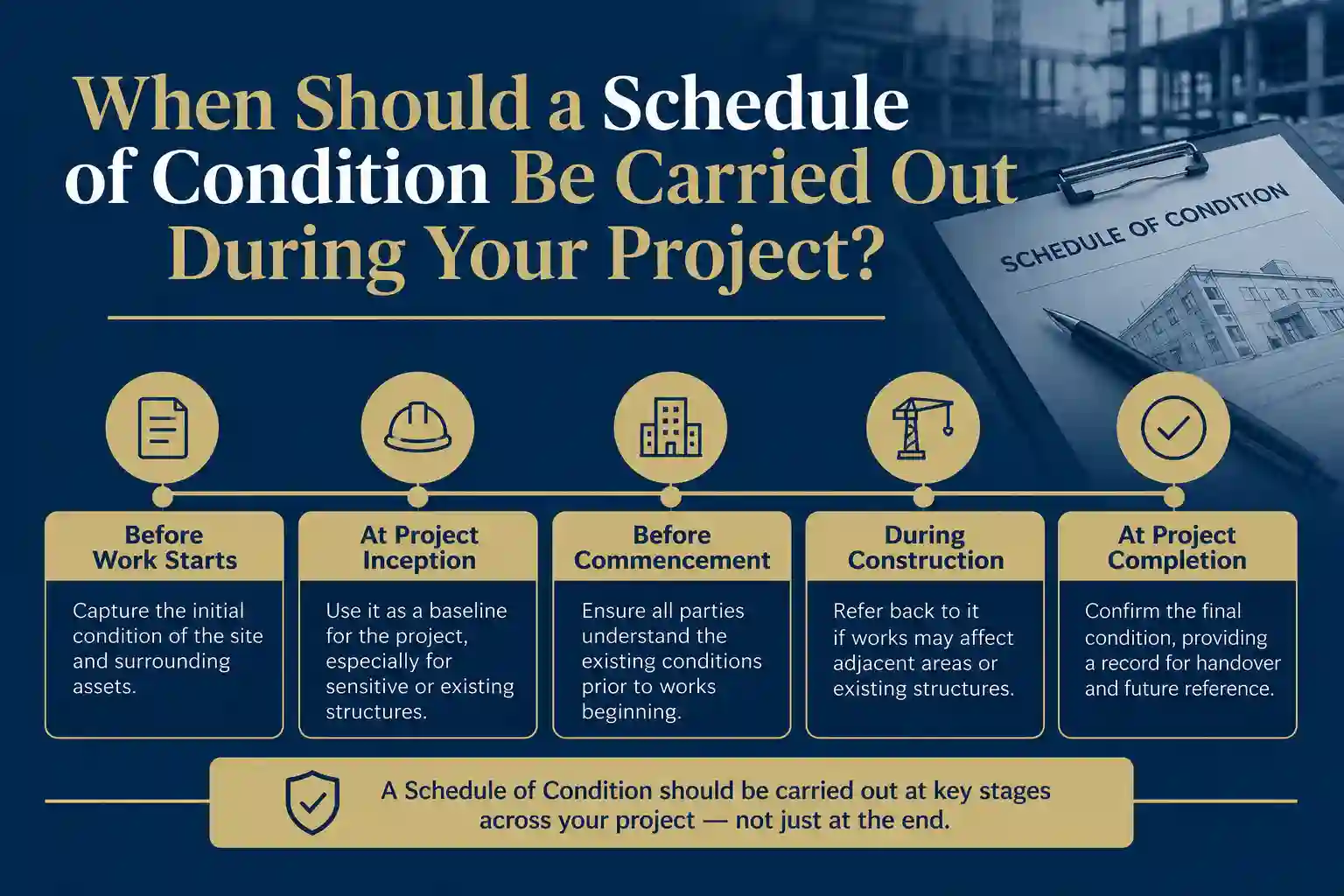
When Should a Schedule of Condition Be Carried Out During Your Project?
Timing is essential.
The inspection should always be completed before any construction activity begins.
This includes before:
- Excavation work
- Demolition
- Groundworks
- Piling
- Structural alterations
- Loft conversions
- Basement construction
- Large extensions
- Commercial redevelopment
Waiting until machinery has already arrived or work has started significantly reduces the value of the report because the property’s original condition can no longer be independently verified.
Ideally, the Schedule of Condition Burnley should be arranged once construction plans are confirmed and before contractors begin on site. Do I Need a Party Wall Agreement? A Complete Checklist for UK Homeowners
This allows enough time for a thorough inspection and provides reassurance to everyone involved before work progresses.

Why Property Professionals Trust Jason Edworthy for Accurate Schedule of Condition Reports
A Schedule of Condition is only as reliable as the quality of the inspection behind it. That’s why choosing an experienced and impartial surveying professional is so important.
Jason Edworthy Burnley provides detailed Schedule of Condition reports designed to give homeowners, developers, contractors, architects and adjoining property owners a clear, independent record of a property’s condition before work begins.
Every report is prepared with a focus on accuracy, clarity and practical value. High-resolution photographs are combined with detailed written observations to create a comprehensive record that can be referred to throughout the project if needed.
Whether you’re planning a home extension, basement excavation, loft conversion, commercial refurbishment or a larger development, a professionally prepared Schedule of Condition can help reduce uncertainty, support smoother communication between all parties and provide valuable evidence should any concerns arise.
Arranging a Schedule of Condition before work begins helps safeguard your investment, reduce the likelihood of disputes and gives your project a stronger foundation for success.
If you’re preparing for building work and want an independent, professionally documented record of your property’s condition, Jason Edworthy Burnley can provide the expertise and attention to detail needed to support a successful project from day one.
FAQs
Q: Can a Schedule of Condition stop my neighbour from making a false damage claim after building work Burnley?
While a Schedule of Condition cannot prevent a neighbour from making a damage claim, it provides a detailed and independent record of the property’s condition before construction begins. This makes it much easier to establish whether any damage occurred during the works or was already present.
Q: Is a Schedule of Condition legally required for every construction or renovation project in the Burnley UK?
Not always. However, it is strongly recommended whenever building work could affect neighbouring properties or where there is a risk of future disputes. It is commonly used alongside Party Wall procedures and major construction projects.
Q: What should I do if damage is discovered after construction has finished despite having a Schedule of Condition Burnley?
Notify the relevant parties as soon as possible and compare the current condition with the original report. The Schedule of Condition provides an objective baseline that can help surveyors, insurers or other professionals determine whether the damage is likely to be related to the construction work and support a fair resolution.
Q: How long does it usually take to complete a professional Schedule of Condition inspection Burnley?
The duration of a professional Schedule of Condition inspection will vary according to the property’s size and complexity. Most homes can be inspected within one to three hours, while larger commercial properties or developments often require a longer visit to produce a detailed and reliable report.
Q: Can photographs alone replace a professionally prepared Schedule of Condition report Burnley?
No. Although photographs capture visible features, they cannot fully explain the condition of a property. A professionally prepared Schedule of Condition includes written observations, structural notes and accurately referenced photographs, giving a much more comprehensive record that can be relied upon if questions arise later.
Q: Who should pay for a Schedule of Condition report during a building project Burnley?
In most cases, the person or organisation carrying out the building work arranges and pays for the report, as it helps protect both their interests and those of neighbouring property owners Burnley.
For further information, please call US on 03300 101 381